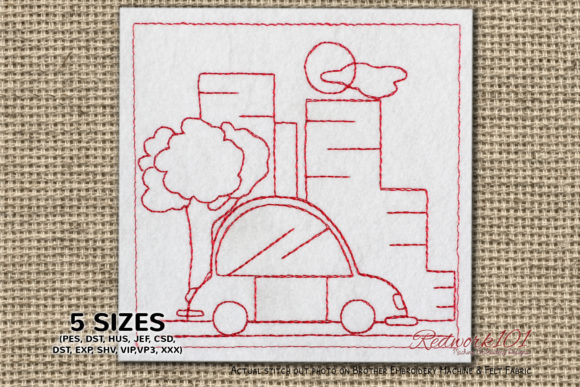
City Redwork Embroidery Design for Craft Fair Products
As I’m laying out the designs for my upcoming craft fair booth, I’m reviewing each embroidery file with a specific lens: will it sell, will it look good in person, and is it practical to produce in batches? Today, I’m looking at City Redwork. The description tells me it’s a city street with a parked car, and the design includes an optional Box Stitch border where the outer color is typically different. This immediately sets a tone. Redwork traditionally uses a single red thread color, but this mention of a different-colored border suggests a more modern, graphic twist on the classic style.
First Impression: Modern Minimalism with a Rustic Touch
The name City Redwork evokes a specific aesthetic. It feels modern and minimal, yet anchored by the traditional “redwork” technique which carries a rustic, handcrafted warmth. This blend is powerful for today’s market. Customers at fairs often look for something that feels contemporary but also genuinely handmade. A city scene done in this style isn’t overly cute or purely decorative; it has a slightly illustrative, story-telling quality. It feels premium because of its simplicity—it relies on clean lines and a single focal color (likely red) to make its statement, rather than complex shading.
The Booth Display Test: Where Will City Redwork Stand Out?
My booth table will have a mix: tote bags, aprons, tea towels, caps, small pouches, pillow covers, and maybe some framed patches. For City Redwork, I need to think about which product gives it the best canvas.
Tote bags and market bags are a prime candidate. The design’s likely clean lines will read well on a larger scale. A city scene on a tote feels urban, practical, and stylish. It’s an easy gift idea. For pillow covers, this could be a standout, especially in a modern or farmhouse-style home. The optional box stitch border frames the design, making it perfect for a centered placement on a pillow.
Tea towels and aprons are tricky but possible. The key is stitch density and fabric texture. Kitchen towels can be rough. If the design has very dense stitching or tiny details, it might pucker or lose clarity. I’d need to test this on a scrap towel first. Caps present a curved surface challenge; a simpler, slightly smaller version of the design might work as a cool accent, but intricate city details could get lost.
Embroidered patches are a fantastic avenue. City Redwork as a patch feels collectible, especially for lovers of city themes. It’s an instant, lower-priced item for the booth. Small fabric pouches or giftable items could use the design as a focal point, adding value to a simple product.
Production Reality: Is It Easy to Batch for a Fair?
Here’s where my professional experience kicks in. Before I commit to producing twenty tote bags with this design, I must consider the hands-on factors.
- Understanding at a Glance: A city street with a car is a clear, relatable scene. Customers will grasp it quickly at the fair booth. This is a selling advantage.
- Size Flexibility: Does it work as a small accent or a large focal design? For batch production, I need to know the ideal hoop size. Without the exact details from the file, my advice is to test it at multiple sizes on scrap fabric. See if tiny elements like car windows or street lines remain crisp when reduced. If they blur, stick to a larger, focal-point application.
- Photographing for Online & Etsy: Clean, minimalist designs like this photograph beautifully. The contrast of red thread (or the main color) against natural fabric like linen or cotton looks sharp in listings. The optional box stitch border creates a natural frame in the photo, which enhances the product shot.
- Repeatable Production: If the stitch density is balanced and not excessively heavy, running multiple items with this machine embroidery design will be efficient. High-density areas can slow production and risk puckering, especially on lighter fabrics like those for pouches.
Critical Use Notes for a Quality Finish
Craft fair products must look impeccable. They’re inspected up close. For City Redwork, I’m thinking about these potential pitfalls:
- Dark Fabric: If using the classic red thread, contrast on dark fabric is poor. This design likely calls for light, neutral backgrounds—linen, cream cotton, light gray. I’ll compare fabric colors in my mockup.
- Textured Towels & Thick Fabrics: Again, test first. Use the right stabilizer to prevent distortion.
- Small Lettering or Tiny Details: The description doesn’t mention text, but if the city scene has minute details (car grilles, tiny bricks), they may vanish on smaller products like caps or pouch accents.
- The Optional Box Stitch: This is interesting. The note says the outer box color is usually different. This means managing two thread colors for the border. For batch production, I’d decide early: is the border integral to the design’s appeal? If yes, I commit to the color change. If not, skipping it simplifies production. It might look more minimalist without it.
The Selling Power: Customer Attention and Product Value
In a crowded craft fair, City Redwork has a quiet strength. It’s not loud or flashy; it attracts customers who appreciate subtle, story-driven art. It adds handmade quality and perceived value because the redwork style is recognizably artisan. On a tote bag, it transforms a generic item into a specific, lifestyle product—the “city lover’s tote.”
For brand consistency, if your shop focuses on urban, modern, or graphic themes, this design fits seamlessly. It strengthens your booth’s narrative. Displaying it on a variety of products (a pillow, a tote, a patch) shows its versatility, which engages buyers. They might imagine it in their home or as a gift.
The commercial embroidery viability is good, provided you’ve confirmed the licensing for selling finished products. As a digital embroidery file, its utility for multiple products makes it a valuable asset for small shop owners.
Final Designer Checklist Before the Fair
My last steps before this design hits my production queue:
- Create at least one real mockup on the intended product (e.g., a tote bag).
- Check thread contrast on the actual fabric.
- Review spacing and overall balance—does the design feel centered and stable on the item?
- Inspect stitch density by running a test; look for puckering.
- Confirm the commercial use rights for the embroidery file.
- Plan the booth display: maybe group all City Redwork products together to create a themed mini-collection that catches the eye.
In summary, City Redwork is a design with strong potential for craft fair and handmade market products. Its modern-rustic blend, clear subject matter, and graphic simplicity make it a versatile candidate for standout items like tote bags, pillow covers, and patches. Success hinges on practical testing—sizing, fabric choice, and stitch management—to ensure the finished products you sell are as crisp and appealing as the design promises to be.